Sunday, November 2, 2008

The end of the affair

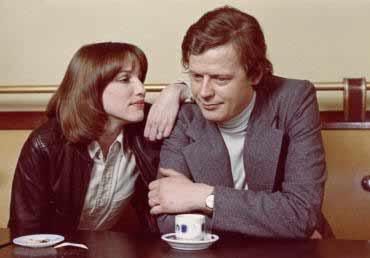
The Aviator's Wife is the first in Eric Rohmer's six-film Comedies and Proverbs series. I watched The Aviator's Wife over two nights while away on a tour of regional Victoria. It's the story of Francois' attempts to woo Anne, a woman five years his elder and of Anne's affair with Christian, an airline pilot. The film opens when Christian visits Anne's apartment early one morning to tell her that things must change as his wife is now moving to Paris. 

The story works as series of fragments, or fractions of the whole, you might say. When Francois follows Christian later that day to Parc Buttes Charmont and sees him lingering there with yet another woman, he assumes Christian to be having another affair. But who is this woman? Further, Francois is 'picked up' by a young woman who joins him in spying on the couple. What does she mean to Francois? Later when he mentions the girl to Anne, Anne all but encourages him to pursue her. 


Each character is unable or unwilling to see what desires others have. In Anne we have a complex, sometimes frustrating woman. Faced with the news from Christian she is clearly wounded, yet shows her defeat with flinty, brittle gestures. Not her for the amateur dramatics. Somehow her reticence rings truer. Yet she treats Francois rather offhandedly. (But he is young and might one day know better.) The story works almost as series of negations, or question marks. Scarcely anyone, it seems, is destined to get what they want.

Richard Brody in The New Yorker recently reviewed The Girl from the Monceau Bakery, a film Rohmer made twenty years earlier. He notes: "His plan is to frame chance as destiny - his great religious quasi-metaphysical theme - and his message, his career-long trope, is the deferral of pleasure in anticipation of true love." 

Chance plays its part in The Aviator's Wife, but not to the point of guiding destiny. The realities of other lives press a little closer here, but the deferral of pleasure is resonant and lasting. The conclusions are more open ended and the film all the more memorable for that. 


Wednesday, October 15, 2008

Eric Rohmer


When my tax return appeared in the mailbox a few weeks back I decided to spend some of it on a bunch of films. I have waited for the re-issue of Eric Rohmer's films, in the way that Louis Malle and Jean Luc Godard have enjoyed. Not to be, or at least, not yet.

So I fired off an order to amazon.uk. Voila, nine days later, The Eric Rohmner Collection. Eight films and the usual extras (short films, trailers and interview with the director). Six films are from the Comedies and Proverbs series, including The Green Ray, Pauline at the Beach, Full Moon in Paris and more. We jumped right in Love in the Afternoon (L'Amour L'Apres-midi). What needs to be said? The film is a typically wry yet surprisingly passionate portrayal of the life of a recently married man. Frederic is a busy young entrepreneur, but he has, shall we say, a rich and vivid inner life. His musings are made real with the re-appearance of Chloe, a young woman Frederic knew before he married.

And there are those incidental pleasures that Rohmer's films offer. The cat and mouse game between what is said and what is meant; the weave of the everyday and the philosophical, the absence of histrionics behind the camera (or in the editing suite). And then there is Paris. The streets of (I think) St Germain de Pres, the cafes, the stlyish offices where the secretaries hammer at typewriters...Made in 1972, the film glows with a look that sums up the period. We suspect the hand of Yves St Laurent. The clothes, in particular those of Chloe, are stunning.


So while I continue to savour this one, I look forward to six or seven more over the coming months.


Saturday, October 4, 2008

Photobooth

So I am dope with a keyboard. 
But this afternoon I discovered Photo Booth. 


Ooh, hoo, Andy Warhol...


Wednesday, October 1, 2008

Elegant camping

We have just come back from a week in South Fremantle. We stayed at our favourite suburban eco-lodge, The Painted Fish. Currently owned by Tim and his wife Shani, it's a slice of old-school Fremantle in a town that is rapidly changing. I grew up around Fremantle and just south of there, so it is a place ripe with memory and association. This is the second time we have stayed at the Fish: finding accommodation in Fremantle is a fraught business. In May we looked far and wide (well, spent a couple of frustrating hours on line) before realising that, yes, we would be paying more to stay in Fremantle than we paid to stay in Paris. Yes, you read that right

Anyway, the upside of the Painted Fish comes with (sorry for this) actual frogs and is close to South Beach. The apartment runs on solar energy, has its own water tanks and the gardens are lush with green vegetables. Tim is a tireless worker and fixer-upper and the Fish is a monument to his labour. 


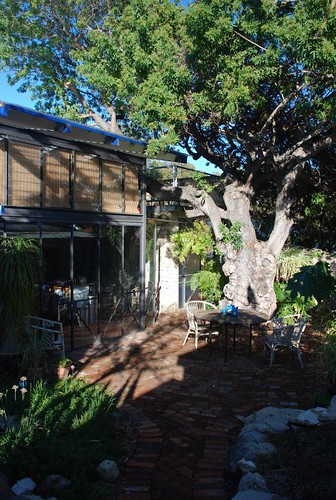
This is a pic of the studio where we stayed. The tree was a magnet for bees and the ponds are home to motorbike frogs, named for the loud but not unpleasant croaking they make in the night. Iris enjoyed riding her scooter by the beach, we walked a lot and ate perhaps a little too well.

South Fremantle is something of a refuge (albeit a pricey one) from the centre of town, which is fast becoming a shell of itself. I am reminded of Peter Carey's story about a town that built a replica of itself that became a tourist attraction, the residents ever after forced to perform their own lives for the amusement of American visitors. Fremantle feels in danger of becoming that kind of place. South Terrace, or the cappuccino strip,  is a long empty shell waiting for the tide of weekenders to fill the bars, cafes and pavements.  With fast swelling suburbs to the south and east, Fremantle becomes a default destination. There are few other choices it seems.

Our trip was something of a flying visit, mainly to catch up with family and friends. I did get to surf at Scarborough with Jim and marked my thirtieth anniversary by riding a single-fin! Jim recently became a father of a handsome boy who looks uncannily like his grandfather. 

We also saw Refat and Elmira Shakir-Aliev. Refat is a doctor of psychiatry but could just as well been a writer. But Uzbekistan in the 1950s was not a great time for writers or journalists. Refat told me a wonderful story about being at school when the teacher came in one morning sobbing with tears. What happened, he wondered? A student said that he saw the teacher hit on the head by a rock. Her tears continued. The class was mystified. The teacher raised her head from the desk and looked out at to the class. "Stalin is dead!" The whole class joined her in crying openly. 
Refat tells this story with not cynical laughter, but laughter of one who long since learned the truth. Elmira's family lost their small land holdings under collectivisation and fled to Uzbekistan. So there were few illusions about Stalin. It puts my own memories of childhood into some kind of perspective. For sure and certain.


Saturday, September 13, 2008

Book of memories

Iris has recently discovered The Jungle Book. 


It's a film that I saw a number of times at the Melody Drive-In when I was about seven. It was the one film we waited and waited to be repeated. 
Nearly 40 years ago. The enjoyment has not diminished. Iris likes it, too.

Sunday, August 31, 2008

Footy Almanac 2008

One of the best things I did in 2007 was a write a little article for my friend Paul Daffey. I assumed that the piece, about a game between the Fremantle Dockers and Collingwood at the MCG, would go onto Paul's website. It did. You can indulge us all by reading it here.

In fact the article formed part of a book, the Footy Almanac 2007, edited by Paul Daffey and Gentleman John Harms. The Almanac collected a lot of amusing, insightful writing about season 2007 from a wide range of blokes, most of whom, like me, are not professional writers.

The good news is that Paul and John have kicked on again for 2008. Here's the cover of this year's edition.


The 2008 Almanac will be out in late November, distributed by Penguin Books. I will have a piece in this one, too, about Fremantle against Richmond at the MCG. So does this make a Penguin author? The pressure is on...


Sunday, August 17, 2008

Paul Weller Melbourne 2008

Another Saturday night, another festival of geezer. Paul Weller worked his way through power supply problems to open his Australian tour at the Forum in Melbourne. Highlights included Changing Man, Eton Rifles and Too Much to Dream Last Night from 22 Dreams.


The sold out crowd matched him year for year, pound for pound. We aint getting any younger, folks. But unlike Morrissey or even Jarvis, Weller has not picked up a younger following. It's not surprising really since his song these days tends have a retrospective glow about it. The urgency of Eton Rifles or That's Entertainment (you want an anthem for a generation, I'll give you an anthem for a generation) is pretty much gone. However, I wouldn't pension him off quite yet. Each of Weller's phases has been so distinctive who is to say whether some other incarnation is not just waiting up the road. At least he is being true to himself. And 22 Dreams floats up enough possible threads for future action to keep us guessing.

One thing that puzzled me to the point of slight fatigue was the endless swapping of guitars. What gives, buddy? A rack at the back of the stage held around a dozen or so. Two battered acoustic guitars, two Telecasters, at least two semi-acoustics and others I can't exactly recall. Between songs seemed to be devoted to achieving Olympic records for guitar switching. I know the back catalogue offers a range of tones and textures (and he's the Modfather, he could what he damn well likes, thanks), but come on. Does Keith Richards change his guitars like this? 

Kim Salmon was recently explaining a how frustrated he became watching  the guitarist of a brand name band who needed a different instrument for every song the guy played. Kim made the point that a good guitarist should, within reason, be able to get the sound out of the guitar that he or she needs. A guitar player, like a writer, should develop their own voice, so that when you hear the sound, you know who's making it. Is it the tradesman, or is it the tools?

Michelle had a different take on all this guitar business. She says Weller's guitar fetish is like Carrie Bradshaw's craving for shoes. It's about showing off what you have got, impressing everyone you know with your vast collection of desirable items. I can't argue with that.