Sunday, January 18, 2009

Le rayon vert

Last week my good lady wife and I went off to see Il y a Longtemps Je T'aime (I've Loved You So Long), the Kristin Scott Thomas film, which I much enjoyed for its restraint and nuance. This is the kind of film one despairs of seeing in these days of Miramax market-researched movie making. In one scene, the belligerent host of a dinner party begins a tirade about the death of French cinema and how Eric Rohmer is the successor of Racine. We're not inclined to take him at his word but the movie is not without its Rohmer-esque moments.


Which caused me to leave left cinema determined to watch Rohmer's Le Rayon Vert. Talk about delayed gratification. When I was a callow youth of, ooh, 23 or 24, Le Rayon Vert screened at the Perth Institute of Film and Television. I remember the reviews leading up to it. The story of a young woman on holiday who can't make up her mind where to spend it, who to be with or what to do with herself. The review took on board Rohmer's low-key cinema and urged people to go along and see for themselves. I don't exactly know why (I was broke?), but I didn't see it. And kept on not seeing it for about 25 years. 


A friend who did see it then was of the opinion that Le Rayon Vert was a bit of a waste of time. "She wanders around and can't make up her mind and then, pffft!, she looks at the sunset and that's it", was her opinion. So hardly a ringing endorsement and really I was none the wiser. That was probably my first brush with ER. I think the first Rohmer film I saw was L' ami de mon amie (My Girlfriend's Boyfriend), probably at the Windsor Cinema in Nedlands.

Suffice to say that the wait to see Le Rayon Vert was worth it. This is the fifth film on the Comedies and Proverbs sequence and is attended by the couplet: 'Ah, for the days/that set our hearts ablaze'. 

Ah, for the days. For this what Delphine seeks and yearns, to have her heart ablaze with a true and unique  love. But it seems that she is bent on ensuring only her own unhappiness and frustration by a kind of neurosis of place and self, played out in Paris, Cherbourg, the mountains and then, finally Biarritz. However Delphine's avoidance of others, of family, of social friendship and casual affairs, has a purpose that gradually reveals itself through the film. This sympathetic, subtle and skillful film-making. Surprisingly most of the dialogue is improvised. Maybe this is why Marie Riviere has such a command of the role: she is creating it as she goes. The ending of the film is exquisite, a mystery, a possibility, an answer and a question. 

In thinking about this film and remember how first missed it I went for a little search about PIFT. I didn't find quite what I was looking for but did turn up a highly detailed portrait of film culture in Perth in the 1960s and '70s. By the time I was ready to go the movies in the 1980s, (a time before Miramax) Perth had a fertile film agenda and a curiosity about the wider world that belied its remote location, its conservative nature, and the difficulties of getting the best world cinema to the screen in a timely way. Tom O'Regan's article, Film societies and festivals in Western Australia, told me quite a lot I didn't know and didn't suspect, about how a band of dedicated folk brought the world to Perth's screens. People of my age benefitted from some challenging programming at PIFT and the Perth International Film Festival, which took place (and still does I presume) in the pine trees at the University of Western Australia. 

Thursday, January 8, 2009

Blighter's rock

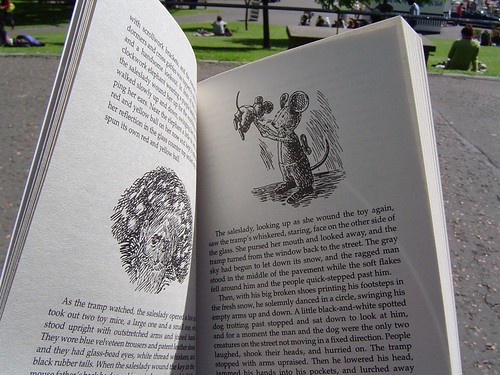
The Russell Hoban community online celebrates the author's birthday every year in a unique way. You see, Hoban is rather attached to yellow paper. Writing on the stuff. Has been for years. He turns 84 on 4 February.

Russell Hoban is the author of more than sixty books for children (including The Mouse and His Child and the Frances books) and more than a dozen novels for adults.  His best known novels include Riddley Walker, Turtle Diary and Kleinzeit. There is even a YA novel, The Trokeville Way, squeezed in there. He still writing and still being published. But back to the yellow paper.


Russell Hoban's birthday is marked simply, quietly, by readers leaving quotes from his work printed on to a page of yellow A4 paper. Why yellow paper? Hoban writes on yellow paper, he says, to ward of "blighter's rock...to intensify the blankness of a blank sheet of white paper is to run to meet trouble considerably more than halfway."

You can catch up on past SA4QE events at the spiffy new blog. Prepare to be surprised 4 February. 


What other ways do readers celebrate the birthdays of their favourite authors?

Monday, January 5, 2009

Youth novels

If you have seen the earlier entries of What Swerves you may have noticed a fondness for geezer rock. Last night I think I broke the mold, getting my zimmer along to the Prince Bandroom for a sold-out dance party of the mind with Lykke Li.


Soup to nuts, the Swedish singer/songwriter/performer played for an hour. Including encore. She hit the stage like a demented Muppet and just went from the there. Needless to say, the crowd went with her every twist, bump and grind of the way. It was a great show. A dance party with a jagged edge. A popstar with a post-punk tilt. She is a thesis, a thesaurus of influence and attitude. Vulnerable, a little bit Betty Blue, a little bit early Blondie.


Her three piece band, all lads who looked like escapees from the Ikea School of Design, rock. The set list was tight, all from her first album Youth Novels, plus a Kings of Leon tune. I was taken by the way the guitar player was kept at the back of the stage, the drummer to the front. This arse-about arrangement kept the focus on Lykke and emphasised the rhythm. Lykke herself occasionally blew hard on a kazoo. And sang through a loud hailer. And prowled the stage like she was brought up by Public Enemy. When she wasn't purring like a young Eartha Kitt. Or belting the bejeezus out of a cymbal.

No wonder I was bleary eyed this morning.

Saturday, December 27, 2008

Pauline a la plage

Pauline a la plage (1983) is a superbly balanced story of four people who meet, where else, at the beach,  becoming entangled in a delicate mesh of amorous misunderstandings. Marion has taken her fifteen-year-old cousin Pauline on holiday to the Brittany coast and there meets Pierre,  an old boyfriend. Almost immediately another, older man, Henri. It has to be said that Henri is un roue vieux, a libertine of sorts. The recently divorced Marion is of course immediately drawn to Henri, despite Pierre 's earnest confession that he is still in love with her. 

Marion is classic Rohmer, her high-minded ideals soon undermined by her own actions. Of course this is done without malice for her, it is simply the way we humans prefer to live our lives.  " A wagging tongue bites itself" is the motto of the film, the third in the Comedies and Proverbs, and thus it proves for Marion. (And yes, it's another very talky Rohmer film, brimming with lively debate and dialogue.)


Henri and Marion getting to grips

All this emotional to-ing and fro-ing is observed with equilibrium by Pauline. And of course Pauline has a little love interest too in Sylvan, whom she meets also a la plage. Their attraction is uncomplicated by the standards of the adults, but Pauline is drawn into their machinations by Henri, acting to save his own skin. For Pauline it's a bruising encounter with the double standards of the adult world. 

Pauline a la plage would make a great YA novel. The teenage characters are deftly and convincingly captured by Rohmer, an absolute master of the late adolescent years. 

A final, not insignificant pleasure is the Brittany coastline in late summer: though there is a glimpse of Mont St Michel, the season is the wind blown, low slanting light of late summer. Not the postcard France yet all the more affecting for it.

Thursday, December 25, 2008

DIY

So the solution to the where to get the buche de noel turned out to be pretty simple. Do it yourself. A quick search of the intrawebs, a couple of hours to weed out the totally chocolate versions and, eh, voila! I made it myself.

You will just have to take my word that, though. I followed this recipe from the BBC website.

I had plenty of raspberries and should have used more in the filling. (Should have read that part a little closer!) But it was enjoyable and surprisingly easy. The roll is a meringue-sponge and not as fragile as I feared. The result was a real crowd-pleaser and very, very tasty. 

Next year I will experiment and try for something lighter. All that cream...but a happy alternative to pudding.

Tuesday, December 16, 2008

Paris swings

Earlier this year we spent three and a half glorious weeks in Paris. Just Paris. In March and early April the weather is cool - even the locals long-faced. Still, we spent a fair amount of time checking the playgrounds. One, because you can't spend all of your time at galleries and cafes (maybe not all), and two because the playgrounds of Paris can be fantastic. 

My good lady wife wrote this story about Paris playgrounds, published in The Age travel section. 

By the way, I am Paris dreaming again, thinking of winter time trip next time. So any advice, tips or information on traveling in France en hiver warmly welcome! 

Monday, December 1, 2008

Buche de Noel


One of the joys of Christmas in recent years has been Buche de Noel, the 'Christmas log'. 

Christmas pudding is never a bad thing, I love it of course, but the Buche de Noel is something else. Essentially a sponge-cream roll with chocolate and fruit you get all the calories and not so much the pudding's heft. It's light, it's sweet, it's creamy.

Anyway, such thoughts were in my mind today when I hopped into La Parisian Pates in Lygon Street. Would LaPP have B de N this Christmas? No, they haven't for the past couple of years. Though they are currently stocking up heavily for Noel.

So where to go? That's my project for the next month. Hunt the Buche de Noel. Game on.