Showing posts with label travel. Show all posts

Tuesday, February 17, 2015

Picture books in France - SLPJ 2014


From vengeful rabbits to playing with guns, the picture books given to French children have a reputation for being uncompromisingly scary – further proof that the French do not coddle les enfants, even at story time.


While it’s true that the French embrace topics and styles that more timid Anglophone picture book publishers would reject, right now, France is producing some of the finest books for children in the world. The best – and there are many too choose from – are visually sophisticated, quirky, funny and daring. And at the Salon du livre et de presse jeunesse in Montreuil, which I was fortunate to visit in November 2014, you can see it all. 

Timothee de Fombelle (seated, right)


When it comes to promoting of books and reading there is nothing in Australia like the SLPJ. This bustling six-day program of book market, exhibitions, author appearances, signings, panels, debates, projections and more attracted 160,000 visitors, most of them children and teenagers. Celebrating its 30th year, the Salon brings plenty of attention to children’s book at exactly the right time of year and does so with a mighty bang - with 450 exhibitors.

Casterman, just one of 450 exhibitors. Publishers also retail from their displays.


Every publisher worthy of their colophon exhibits here: the big like Flammarion, Gallimard and Casterman (publishers of Tintin); the edgy independents like Editions Thiery Magnier and Editions Fourmis Rouges; and icons like l‘ecoles les loisirs (celebrating 50 years in 2015) and Albin Michel Jeunesse. There are specialist art book publishers (yes, for children) and specialist human rights publishers (yes, also for children); and the national library promotes its programs for professionals. This is the epicenter of French book publishing for children and teenagers. (A full list of exhibitors here.)

Saturday crush for 'une dedicace'


Authors appearing included Quentin Blake (also featured in large and beautiful exhibition), Meg Rosoff, Cathy Cassidy and local heroes including Pénélope Bagieu and Timothee de Fombelle, author of the brilliant Toby Alone. de Fombelle's new novel, Le livre de perle, won Best European YA novel in the Salon's awards. Hundreds of authors appear, and even more illustrators, since having your book ‘signed’ with original artwork, une dedicace is de rigueur.

But there is something just as important as the commercial and cultural side to the Salon, and which gives the event its soul: that is the connection to community. The strong relationship between the Salon du livre et de la presse jeunesse, the local government, the national government and the publishing industry that makes the event so successful. This is the second major French book festival I have attended, and Australian publishing could learn a lot from this kind of integrated planning and promotion that makes SLPJ so successful. It was also striking to see how warmly the publishing people I met embraced the Salon: they genuinely enjoyed being a part of it, meeting their customers and their colleagues. Thirty years on, this one has a lot energy and purpose.
Posters appear in all the Metro lines


Montreuil is in the east of Paris and just beyond the peripherique, that sometimes real, sometimes imaginary line that marks the start of the banlieue, the suburbs. So imagine a book festival in Braybrook or Dandenong or Blacktown. The Seine-St Denis local government, which supports the SLJP, is among the most left-wing districts in Paris. It’s home to many thousands of Malian migrants (it’s sometimes called Little Bamako), with more than 100 languages spoken.

Outside SLPJ, Montreuil, in Seine St Denis


“Montreuil is always a fight”, one foreign rights agent confided to me. What she meant is, that it is always a fight to get respect, to get the resources, to get the media coverage for this major celebration. In director Sylvie Vassolo, the Salon has a leader prepared to stand up for children’s books. Politics is in her blood and her training: prior to leading SLPJ, Sylvie Vassolo headed the national union of Communist students.

A selection of the books bought at SLPJ


Children and teenagers arrive in school groups, or with childcare centres, after-school recreation and youth clubs, and with parents. Thousands of parents and children pay 6 euros (about $9) admission and receive a 4 euro book voucher (children are free). They can be seen exploring, reading, discussing, buying and delighting in the hundreds of stalls, events, exhibitions, book signings. Outside it might be chilly, but the scenes on the three floors of a scruffy convention centre are hectic.

Links:

At the time of this trip I was the Program Manager for the Melbourne Writers Festival 2011-2015. Travel to the Salon du livre et de la presse jeunesse was kindly supported by the Consulate-General of France, Sydney. Special thanks to Emmanuelle Denavit-Feller, and to staff of the publishing houses, all of whom made me welcome, answered my questions, shared their knowledge and passion, and put up with my ordinary French.
A version of this account first appeared on the Wheeler Centre Dailies


Saturday, November 3, 2012

Krakow Bound

I wasn't planning to go to Poland. But about eight weeks ago the opportunity came up to attend a conference as part of Reading Malopolska, exploring Cities of Literature networks. Krakow, Poland's 'second city', after capital Warswaw, is bidding for UNESCO City of Literature status. Melbourne was awarded this title about three years ago.

So last week I spent three days in Krakow, in the company of City of Literature representatives. I went wearing my Melbourne Writers Festival hat, to see about developing contacts with other cities and people as part of this group. You can see a nice video summary here.


Now there are six Cities of Literature: Edinburgh, Melbourne, Dublin, Iowa, Reykjavik and Norwich. Almost all English language cities, I'm sure you noted. But here comes a new wave of applicants from cities including Krakow, Naples, Heidelberg, Tartu and Prague among them.


What is most interesting about the Cities of Literature is the different responses that each makes to the brief. In Melbourne thus far it has been mostly "top-down": the establishment of the Wheeler Centre being the flagship. But in Edinburgh, Dublin, Iowa and elsewhere, leaders have taken a vigorous grass-roots approach to the promotion of reading and to spreading an awareness of each city's literary heritage.

Which brings us back to Krakow. Because if the city can boast anything, (though boasting isn't the style of this quiet, historic city), it's literary backstory. Krakow is home to two - count 'em - Nobel laureates, Czeslaw Milosz and Wislawa Szymborska, and a heritage stretching back a millennium at least. The challenge for the city's cultural workers is figure out how to move forward without dispatching this extraordinary heritage. A country whose own political heritage has been so disrupted might well be anxious how 'modernisers' try to re-define Polish literature to the world. The conference organisers were acutely mindful of such anxieties, or the potential for such. But culture that exists only in a glass case is either dead or about to be so, and the opportunities for UNESCO recognition are an opportunity to revive the heritage, and take it outside the country. It might also be a platform for new writers to engage new audiences, at home and abroad and validate new endeavours.


Krakow is a city of extraordinary cultural riches, not just literary. For one, there is a da Vinci painting Lady With an Ermine that you can see, relatively uncrowded, in a medieval castle. For two, there is the biggest medieval market square in Europe (beneath which you can wander in the 13th century foundations). And for three, there is the 14th century gothic altarpiece by Veit Stoss. A truly extraordinary work of religious art, with a backdrop of towering stained glass.


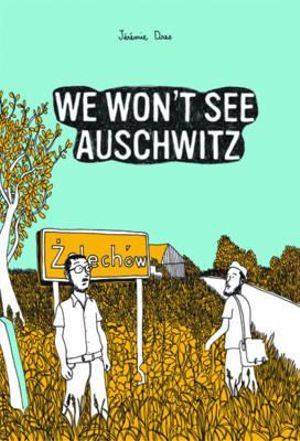
Krakow is also the departure point for anyone wanting to go to Auschwitz, about 40 kilometres from the city. While I have absolutely no objection to anyone wanting to go the site of the concentration camp, I have no desire myself. I feel there are plenty of ways for me to understand and examine the realities and legacies of the genocide, but physically going there is not something I want to do. So it was quite some coincidence to discover a few days later in a bookshop (Foyles, in London), the graphic novel We Won't See Auschwitz by Paris-based Jeremie Dres. The book is a straightforward account of a trip taken by the writer and his brother to Poland in search their family's past. The illustration style appears simple, though it's nuanced and economical. I like the documentary approach. It's not without a few lighter moments, and the journey is presented without complication or need for artifice.


Dres is relatively un-conflicted about not visiting Auschwitz, (spoiler alert: the title is not ironic, there is no surprise twist), since he discovers amid the suspicion of lingering anti-semitism, a new wave of endeavours to bring Jewish heritage and culture back to Poland. there are people working on humanitarian, cultural and legal fronts to re-establish a new space for Polish Jews. Rather than remain fixated in one way of remembering the past, Dres draws us towards a view that there is more going on in Poland than a simple reading would lead us to believe.


Thursday, October 29, 2009

Angouleme dreaming

When we went to France last year (like it's something we do often), the idea jumped into my head that I might come back and explore the world of la bande dessinee. Everybody knows the French and Belgians are nuts about graphic novels and everybody knows and has probably read some Tintin and Asterix.


But the whole French graphic novel thing jumped to the front of my mind when, coincidentally, Shaun Tan won the Angouleme International Comics Festival Prize for La Ou Vont Nos Peres. Although we probably know it best as The Arrival. So yay, Shaun.


Today I read the Angouleme Comics Festival is 'the largest and most significant comics festival in the world. (So says Bart Beaty in Unpopular Culture, transforming the European comic book in the 1990s). So you might say that to win such a award is the comic universe equivalent of the Booker Prize. Or Le Tour de France.

Anyway, I got thinking that I might like to go there to find out how the French do things and why it is that la bande dessinee maintains such a broad audience. Why is it that comic books are seemingly not viewed as the preserve of pimple squeezing dweebs, would-be manga cultists or indie hipsters? Hey, maybe the French really do look down the Gallic conk at comic book readers. But what the heck, the industry is large, diverse and ever-changing. Not without its problems I'm sure but big and complex.

At least I hope so. Because this week I learned the good people at the Copyright Agency Limited have provided me with a little money to travel to Angouleme in January 2011 to attend the festival. So yay, CAL. I would love to go this January, but the year's gap gives me time to plan and set up other activities. And save some euros. And keep learning the language.


Tuesday, December 16, 2008

Paris swings

Earlier this year we spent three and a half glorious weeks in Paris. Just Paris. In March and early April the weather is cool - even the locals long-faced. Still, we spent a fair amount of time checking the playgrounds. One, because you can't spend all of your time at galleries and cafes (maybe not all), and two because the playgrounds of Paris can be fantastic. 

My good lady wife wrote this story about Paris playgrounds, published in The Age travel section. 

By the way, I am Paris dreaming again, thinking of winter time trip next time. So any advice, tips or information on traveling in France en hiver warmly welcome!