Even Iggy Pop.
Thanks to the wonderful Filles Sourires.
Thursday, February 11, 2010

Monday, February 8, 2010
Je m'appelle Mike
The new year clanks into life and that can only mean one thing: back to school. In my case, that means French classes on Saturday morning.
This is, I think, the fifth year that I have been learning. Seems like forever, which is strange because I hardly command the language. In fact, I'm still at lower high school level. Get through this and I could enrol at VCE level. No thanks, I have quite enough stress already.
Back in the class on Saturday with some familiar faces and some new ones, I felt the anxiety levels rise instantly. I kind of stage fright takes over.
But I can't imagine not studying. I am this stage of beginning to read reasonably. Not reasonably well, but I can read for sense. Which is progress on a year or two. I lapse into franglais at moments of doubt and it's my aim this year to do away that habit as much as possible. If that fails, well, there is always large hand gestures. But I still have a long way to go.
I spent the summer revising and going back to absolute basics. A really useful podcast that I stumbled upon (actually, my daughter found it) is the Verbcast. It's designed as pilot program for high school students in the UK and uses relaxation and visualisation techniques. So effective are these methods that the first three times I tried I fell asleep. Something about the offer to imagine a isolated beach in the south of France, waves lapping the ankles. Breathe in through the mouth, and out through the nose. Shut everything else out of your mind. Zzzzzz.
Verbcast uses a simple and consistent method to introduce conjugations of the most common verbs. Very effective it has been. Overcoming a feeling of anxiety is for me one of the most important steps in learning and this one helps - a lot. You can download Verbcast for free at iTunes.
Friday, January 29, 2010
Vale Eric Rohmer
Soon after I moved to Melbourne in 1996 my girlfriend, now wife, and I went to see A Summer's Tale (Conte de ete) by Eric Rohmer. The film was showing at the now defunct Carlton Movie House, or the bughouse as it was affectionately known. All cinemas were called 'the bughouse' once upon a time, but this one truly earned its title. Maybe the title.
One of the projects of this blog has been to write about the films of Eric Rohmer, which over the past 20 years, have given me more pleasure than the work of any other director. I recently started on the Tales of the Four Seasons, though I have seen these films in the cinema.
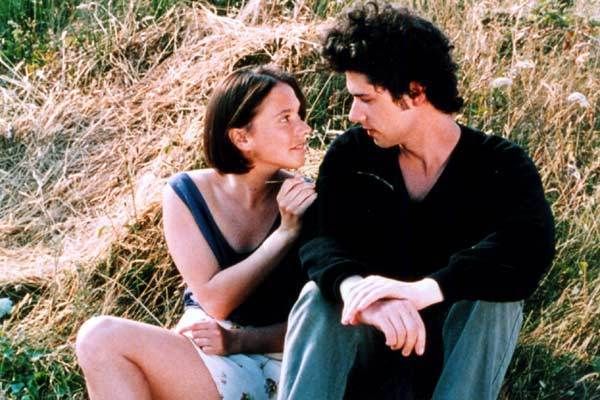
But Gaspard remains diffident. Lena finally arrives, and proves to be real ball-breaker, but in the meantime Gaspard has become interested in Solene, a willowy teenager looking for some holiday action. As Gaspard bounces between Lena and Solene it is Margot who remains constant. But even she has an alibi of sorts, a reason not to become involved. Margot's boyfriend is in the Pacific, an anthopologist who frequently abroad. One gets the feeling though that were Gaspard to make a decision Margot would not be disappointed.
Inside, the cinema wasn't merely dark, it was gloomy and disheveled. The foyer was tiny, the box office truly poky. But the films!
One of the projects of this blog has been to write about the films of Eric Rohmer, which over the past 20 years, have given me more pleasure than the work of any other director. I recently started on the Tales of the Four Seasons, though I have seen these films in the cinema.
A Summer's Tale is the story of Gaspard, a young man on holiday at the beach in Brittany. His girlfriend Lena has more or less blown him off; she is on holiday elsewhere and without explanation, delays her arrival. So Gaspard walks the wide empty beaches, or sits at home practicing his guitar and writing songs. At a cafe, Gaspard meets Margot, a pretty, slightly boyish waitress who more or less takes him under her wing.
But Gaspard remains diffident. Lena finally arrives, and proves to be real ball-breaker, but in the meantime Gaspard has become interested in Solene, a willowy teenager looking for some holiday action. As Gaspard bounces between Lena and Solene it is Margot who remains constant. But even she has an alibi of sorts, a reason not to become involved. Margot's boyfriend is in the Pacific, an anthopologist who frequently abroad. One gets the feeling though that were Gaspard to make a decision Margot would not be disappointed.
But Gaspard dithers, and doubts and delays. But all too soon summer's lease must expire and the holidays end. Indeed the ending of the film is as finely balanced in its sweet sadness as any of Rohmer's movies. It's not the neatly folded ending of My Girlfriend's Boyfriend. Here is a brief, piercing moment about the missed oppotunities, perhaps that sadness lies more in the things we don't do than in the things we do. Life is all about Gaspard and he, watching it spin and turn, loses the things most worth catching.
Of course Gaspard has the usual litany of reasons for his evasiveness: some to do with commitment, some to do with a lack of belief in others. Rohmers delicately holds these notions up to the cool Brittany sunlight and finds them terrribly wanting.
A Summer's Tale is full of typically rapid exchanges (thank god for subtitles) as Gaspard and his girls walk the wide beaches at low tide. Many of these scenes were shot drawing a camera on a large trolley (or 'dolly' as I believe film-folk like to call them), some of the scenes stretching over hundreds of metres at a time. The space allows scenes to play out with minimal editing and is one reason why the performances achieve such naturalness. (Another is the delightful Amanda Langlet, who brought the magic to Pauline a la plage.)
There is some improvisation in the dialogue. Rohmer's ability to match his methods with his means was one of his great strengths. There appears to be so little artifice in his films. Very little lighting; almost never any music in post-production, and actors like Langlet who seemed to do their best work in his films. It amazes me that the young heroines of his films didn't all go on to great careers.
Rohmer made his own kind of film. You see the influence in films like The Summer Hours and even a little in The French Kissers. (Although he would surely disdain the gross-out aspects of the boys.) He is even referred to directly in I've Loved Yo So Long. But none of this quite equals the calm, watchful, steady gaze of Rohmer's camera. Or the exquisite, understated comedy. Or the tenderness of emotion that his seemingly endless gallery of young actors brought to the screen.
Eric Rohmer died on 11 January, 2010, aged 89.
Wednesday, December 23, 2009
A year of Serge?
Sometime next year, perhaps at the French Film Festival in March or April, the Serge Gainsbourg biopic will be all over the cinema. So expect an upsurge in interest in the great songwriter, singer and arranger.
In English speaking countries Serge Gainsbourg's name tends be mentioned just before a smirk. All that saucy French nonsense, it's not real music, is it? Oh, it is most certainly is. For me, he's easily in the company of the Brian Wilsons and John Lennons of this (or the other) world. I think of him as akin to Joe Strummer for intensity and charisma.
In English speaking countries Serge Gainsbourg's name tends be mentioned just before a smirk. All that saucy French nonsense, it's not real music, is it? Oh, it is most certainly is. For me, he's easily in the company of the Brian Wilsons and John Lennons of this (or the other) world. I think of him as akin to Joe Strummer for intensity and charisma.
Nicknamed 'Cabbage head', he still persuaded Brigit Bardot and Jane Birkin to share his breakfast coffee.
So I await the film version of his strange, troubled and dramatic life with much interest. With a little luck it may even encourage a wider appreciation of his music.
So I await the film version of his strange, troubled and dramatic life with much interest. With a little luck it may even encourage a wider appreciation of his music.
Wednesday, December 9, 2009
Notes on the future, notes on the past
If you don't like pretension, look away now.
Over the past couple of years it seems I have become a bit of francophile. I know this puts me in a difficult position. The Rainbow Warrior, diplomatic slipperiness, Mr and Mrs Sarkozy. And that's before we look much of the recent movie output.
Since about 2006 I've been learning the language, slowly and perhaps quite badly. So I'm not quite ready to tackle Proust, but if I suddenly found myself lost on the Rue de Rivoli I could probably survive by ordering take-away coffee and turning left at the bank.
Learning the language was a response to a planned trip that I took with my family (less one) last year. I had spent about a fortnight in France in 1989 without so much as a bonjour to bless myself with.
At that time, I didn't 'get' France and I didn't enjoy it. The main reason was that I felt so hugely disadvantaged the entire time. Nothing was any fun. I mostly remember splitting headaches, possibly from the coffee, and walking for miles around Paris without ever seeing much. I know, I know...
So having been to France and satisfied my earlier frustration, why do I remain fascinated by the place? It is partly the exotic qualities. Melbourne is a great place to live but you couldn't call it one of the world's great romantic places. Lots of adjectives but not that one.
It is partly the myth of France that attracts me. I am fascinated by the contradiction between the old world and its modern manifestations. A country that is both progressive and deeply conservative. Paris pretty much invented the avant garde. Entwined in its history is a deep concern for the rights of man and yet the present is riven by racism. France is the seedbed of existentialism (and many other isms) and the place of so many grand cathedrals. And so on and so on.
When I went to university, cultural studies and semiotics were all the go. Out with the Anglo-American school, in with the French: Saussure, Roland Barthes, and hot on his heels, Foucault and then the feminists. I didn't get too far with all of this. Reading Sausurre and Barthes was a lot like going to France and not speaking the language. You could observe, and it could be vaguely enjoyable, but for the most part one had not a bloody clue what was going on.
I have been thinking about Barthes lately because I have been reading a book on French and Belgian comics, which takes an old school semiotic approach French and Belgian comics. It's a closely argued 200-odd pages on how meaning is made in la bande dessinee. It was a pleasure to revisit this kind of writing and thinking, this analytical approach to a subject. It was like revisiting a younger self.
Now, I feel like I get it. I get that the task the theorist undertakes is to tease out meaning, not to pronounce it. I get on board and enjoy the game, see how the writer investigates the relational nature of meaning. And in a funny way, I don't read it with the same earnest approach that I might have 25 years ago. I enjoy the pursuit.
I think those early university encounters, even in their frustrations, set me up for a longer interest in France. I should repeat that I didn't ever make great headway in matters theoretical. I lacked the truly obsessive character needed to fully get ahead in that. But I tried. It was like I didn't really understand what theory was for.

Roland Barthes was like a sideways entrance into French culture of the period he was writing about. Perhaps what Barthes did was point me towards a world that I didn't understand. But I did enjoy the view of the world that certain French writers and thinkers provided. Whether it was the dandyism and style of Jean Cocteau's films, the wryness of Louis Malle or Philippe Noiret, or a dozen other films, there is something revealing and serious about this stuff.
I also enjoyed, if that is the right word, the books of Simone de Beauvoir. All her four books of her autobiography; The Second Sex, The Blood of Others, She Came to Stay, The Mandarins. Especially that one. By the time I read it, I knew enough about de Beauvoir to piece together some of the facts and the fictions. Perhaps I dreamed of going to another country and starting a new life with another lover, as the character does in The Mandarins. Maybe, can't remember.
I have just finished reading to my daughter a French novel (translated, of course), Toby Alone by Timothee de Fombelle. The book has a little motif towards the end that reminds Toby that his life really only has one true thread and he can turn his back on it but it will always be there. That there is no running away, just as it was for de Beauvoir.
While we were in Paris, we made a point of going to Montparnasse Cemetery to see Simone de Beauvior's grave. It is a simple, quite plain headstone, near the limestone wall. I confess that I was just a little bit cross that she is sharing eternity with Sartre, who, I'm afraid, I see as very much her inferior. Their lives were far more complicated than the ending implies, but as another poet said, such is life. It was, I think, de Beauvoir who really got me hooked on French culture. In her autobiographies she is both a close-hand observer and a critic. An insider and outsider. Think of the reception that she received on the publication of the Second Sex! C'est scandaleux! Her books so fascinated, informed, confounded and yes, inspired me, that 25 years later I am still looking for answers.
I encountered Simone de Beauvoir's books at a time that it was absolutely crucial for me. They provided escape, challenge and insight at a time when I needed certain things to be explained. In writing about her past, she provided me with the sense of a future.
Over the past couple of years it seems I have become a bit of francophile. I know this puts me in a difficult position. The Rainbow Warrior, diplomatic slipperiness, Mr and Mrs Sarkozy. And that's before we look much of the recent movie output.
Since about 2006 I've been learning the language, slowly and perhaps quite badly. So I'm not quite ready to tackle Proust, but if I suddenly found myself lost on the Rue de Rivoli I could probably survive by ordering take-away coffee and turning left at the bank.
Learning the language was a response to a planned trip that I took with my family (less one) last year. I had spent about a fortnight in France in 1989 without so much as a bonjour to bless myself with.
At that time, I didn't 'get' France and I didn't enjoy it. The main reason was that I felt so hugely disadvantaged the entire time. Nothing was any fun. I mostly remember splitting headaches, possibly from the coffee, and walking for miles around Paris without ever seeing much. I know, I know...
So having been to France and satisfied my earlier frustration, why do I remain fascinated by the place? It is partly the exotic qualities. Melbourne is a great place to live but you couldn't call it one of the world's great romantic places. Lots of adjectives but not that one.
It is partly the myth of France that attracts me. I am fascinated by the contradiction between the old world and its modern manifestations. A country that is both progressive and deeply conservative. Paris pretty much invented the avant garde. Entwined in its history is a deep concern for the rights of man and yet the present is riven by racism. France is the seedbed of existentialism (and many other isms) and the place of so many grand cathedrals. And so on and so on.
When I went to university, cultural studies and semiotics were all the go. Out with the Anglo-American school, in with the French: Saussure, Roland Barthes, and hot on his heels, Foucault and then the feminists. I didn't get too far with all of this. Reading Sausurre and Barthes was a lot like going to France and not speaking the language. You could observe, and it could be vaguely enjoyable, but for the most part one had not a bloody clue what was going on.
I have been thinking about Barthes lately because I have been reading a book on French and Belgian comics, which takes an old school semiotic approach French and Belgian comics. It's a closely argued 200-odd pages on how meaning is made in la bande dessinee. It was a pleasure to revisit this kind of writing and thinking, this analytical approach to a subject. It was like revisiting a younger self.
Now, I feel like I get it. I get that the task the theorist undertakes is to tease out meaning, not to pronounce it. I get on board and enjoy the game, see how the writer investigates the relational nature of meaning. And in a funny way, I don't read it with the same earnest approach that I might have 25 years ago. I enjoy the pursuit.
I think those early university encounters, even in their frustrations, set me up for a longer interest in France. I should repeat that I didn't ever make great headway in matters theoretical. I lacked the truly obsessive character needed to fully get ahead in that. But I tried. It was like I didn't really understand what theory was for.
Roland Barthes was like a sideways entrance into French culture of the period he was writing about. Perhaps what Barthes did was point me towards a world that I didn't understand. But I did enjoy the view of the world that certain French writers and thinkers provided. Whether it was the dandyism and style of Jean Cocteau's films, the wryness of Louis Malle or Philippe Noiret, or a dozen other films, there is something revealing and serious about this stuff.
I also enjoyed, if that is the right word, the books of Simone de Beauvoir. All her four books of her autobiography; The Second Sex, The Blood of Others, She Came to Stay, The Mandarins. Especially that one. By the time I read it, I knew enough about de Beauvoir to piece together some of the facts and the fictions. Perhaps I dreamed of going to another country and starting a new life with another lover, as the character does in The Mandarins. Maybe, can't remember.
I have just finished reading to my daughter a French novel (translated, of course), Toby Alone by Timothee de Fombelle. The book has a little motif towards the end that reminds Toby that his life really only has one true thread and he can turn his back on it but it will always be there. That there is no running away, just as it was for de Beauvoir.
While we were in Paris, we made a point of going to Montparnasse Cemetery to see Simone de Beauvior's grave. It is a simple, quite plain headstone, near the limestone wall. I confess that I was just a little bit cross that she is sharing eternity with Sartre, who, I'm afraid, I see as very much her inferior. Their lives were far more complicated than the ending implies, but as another poet said, such is life. It was, I think, de Beauvoir who really got me hooked on French culture. In her autobiographies she is both a close-hand observer and a critic. An insider and outsider. Think of the reception that she received on the publication of the Second Sex! C'est scandaleux! Her books so fascinated, informed, confounded and yes, inspired me, that 25 years later I am still looking for answers.
I encountered Simone de Beauvoir's books at a time that it was absolutely crucial for me. They provided escape, challenge and insight at a time when I needed certain things to be explained. In writing about her past, she provided me with the sense of a future.
Thursday, November 12, 2009
Young marble neighbours
Last night was hot. Windows open, sounds drifting in from neighbour's house. A kind of not quite funky, proggy bass-driven thing. A bit kraut-rock, a bit I dunno what. But it reminded me of something.
It wasn't annoying though it wasn't exactly what I would choose to put on. The neighbours are the kind of demi-monde bohos that Brunswick is supposed to be too expensive for anymore.
So I popped next door. And gave them this. In a neighbourly sort of way.
I can hear it playing through the window now.
Wednesday, November 4, 2009
The illustrated Shakespeare and Co.
Over at the ever-fabulous Baudade you can follow her progress - illustrating the walls of Shakespeare & Co, the famed Paris bookshop.
In bookshop news closer to home, I popped in to Readings Carlton tonight to hear Robert Forster talk about 10 Rules for Rock and Roll, his reviews and essays. He's a fantastically balanced writer about music, possessed of a snappy turn of phrase and keen pair of ears. He's also a modest and straightforward speaker on music. Which is amazing given that he opened the conversation tonight by playing a new song called I Love Myself A Lot and I Always Have. He remains a diamond, always curious, never grinding an axe.
You can hear Robert talking about the 10 Rules of Rock and Roll, courtesy of ABC Perth.
Subscribe to:
Posts (Atom)