The excellent ToutenBD.com, the French website dedicated to all things French graphic novels, recently posted the annual health check of the industry. Despite the economic straits France finds itself in, the comics industry continues to grow. While the overall picture seems quite healthy, a closer look reveals a more interesting picture. And students of the Australian publishing sector will certainly draw some parallels with our colleagues francaise.
Being on holiday and at something of a loose end, I have written a translation of the article, and added links. ToutenBD.com were contacted for permission but have not yet replied. You can read the original version at the website.
In the meantime, allons-y!
Bande dessinee is 2011: the boom of the sure thing
The annual meeting of the Bande Dessinée Critics Association (Association de critiques et tournalistes de bande dessinée) noted again this year the growth of the production of albums (books) -- but with the caution that publishers are supporting the safe bets.
The traditional annual report from Gilles Ratier, the general secretary of the Bande Dessinée Critics Association (ACBD) has been delivered for 2011.
For the sixteenth consecutive year, the production of albums has increased: 3.04% against 2010; an increase of 162 titles, for a total of 5,327 albums. However the report noted "the economic conditions are hardly favourable for industry, which for three years has lacked a strong engine. Hence, we have a general climate of watchfulness, highlighting safety first and anxiety!"
Watchfulness in effect because of the 5,327 albums only 3,841 are strictly new (of which only 1,577 originated in francophone Europe). The traditional publishing sector (le secteur patrimonial) is fully expanded, with 1058 new releases, compilations or bind-ups (980 in 2010), 224 woks dating from more than 20 years published finally in album and 31 francophone series reprised or continued by new creators.
Watchfulness also because in 2011 on 99 "sure things" (valuers sûres), had sales of more than 50, 000 copies and bestowing the bulk of sales on this sector. At the head of these 'locomotives' are: XIII (500,000 copies); Kid Paddle (360, 000) and Boule et Bille (253,000). Counting manga, ten series (from five publishing houses) provided 50% of sales, Naruto at the head (250,000 copies of each of three titles in the series).
Looking at publishing houses, 310 publishers produced bande dessinée in 2011. And yet the trend towards concentration is again confirmed: four groups accounted for 43.6% of production. With the acquisition of the majority share of the publisher Soleil by Guy Delcourt, Delcourt became by far the biggest producer of albums with 840 titles, being 15.77% of production.
On the economic graph, the prize nevertheless gos to Médias-Participations group (Dargaud, Le Lombard, Dupuis, etc).
The report noted the strong success of the bande dessinée blogs, which have become a "fishtank" (un vivier) for the print publications. On the other hand few were seduced by the e-book. And bande dessinée is always well exposed in the news stands, with 76 specialist journals.
FIN
So, thanks again to ACBD and ToutenBD. And apologies for all infelicities in 'la traduction'.
Saturday, January 14, 2012

Tuesday, November 1, 2011
Viewpoint again
The latest issue of Viewpoint: on books for young adults, includes my review of two recent graphic novels. Neither book fits easily into the received notion of 'graphic novel', which is probably why I like them so much. Thanks to Pam Macintyre and the team for publishing the reviews.
A Taste of Chlorine
Bastien Vivès (Jonathan Cape, hbk)
and
Radioactive: Marie & Pierre Curie A tale of love and fallout
Lauren Redniss (It Books/HarperCollins) hbk


A Taste of Chlorine (Goute de Chlore) by Bastien Vivès, the young Parisian writer/illustrator won the Revelation Award for best first book at Angouleme in 2009, Europe’s biggest comics festival. Simply put, A Taste of Chlorine is the story of a teenage boy ordered by his doctor to swim regularly to repair a damaged spine. At the pool, he comes into contact with a young woman who offers him advice on swimming technique and companionship. As their tentative relationship develops, companionship leans towards attraction.
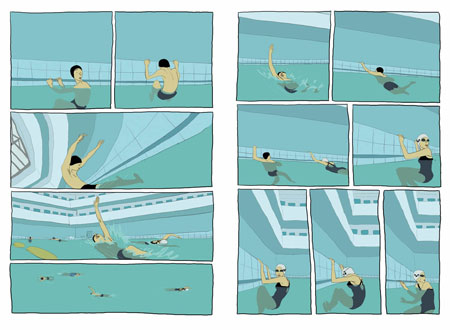
Most of the action takes place at the pool and in the water. Bastien Vives delights in depicting the body’s curves and lines in all its various positions, shapes and poses. What, after all, is swimming, if not contorting the body into striking shapes? All those aquatic blues and greens lend the book a certain cool mood, punctuated by the black ribbon of the lap lanes. The minimalism of the colour and location allows the viewer to attend more closely to the emotional exchanges, since below the surface however and emotional drama of subtly and force plays out. In this regard A Taste of Chlorine is a remarkable debut, a book where the artist shows us what he can do within the tight confines of setting. Vives exploits perspective and point of view with some authority. It is also a book that is long on visuals and lighter on text, but that doesn’t mean that viewers will simply skim the book (The act of swimming is not a language-based activity, so why not remove all but necessary language from the pages?) The drawing sometimes appears simple, even at times rudimentary, but this is somehow in keeping with the story’s unaffected emotional tone.

One reads this book as one watches a film, where the dynamics of space and gesture are all important. Vives also neatly exploits the use of the ‘frame’ or panel as a way of isolating his characters. There are points where the panel behaves like the lanes of a pool, bringing the swimmers closer yet exquisitely resisting the shared moment so desired by the young man. A Taste of Chlorine does not give up its secrets easily. Perhaps it doesn’t need saying that the book will not be to everyone’s favour. But this quiet, deftly told drama challenges some received ideas of the graphic novel. The ending is enigmatic, open, and will have keen viewers returning again and again, to tease out the elusive relationship at the heart of the story. A Taste of Chlorine is also an example of the innovation that the French graphic novel, la bande dessinee, is capable of achieving, as artists and writers explore the creative potential of the form.

Radioactive works differently. It’s a book relatively long on text and strictly speaking, is not really a graphic novel. Well, insofar as it does not use the panel structure to tell its story, and avoids speech balloons. But the life of Marie Curie, the remarkable scientist, is passionately communicated through sophisticated picture-making and bold page design. Again, the drawing style has a slightly ungainly, improvised manner, which is belied by the confident use of colour to shape mood and emotional response in the reader. After all, an account of a scientist whose major work was more a hundred years ago, may not immediately hold great interest for the reader today. That this world is remote gives way at the first glance of the endpapers. (Doubt stops at the border.)
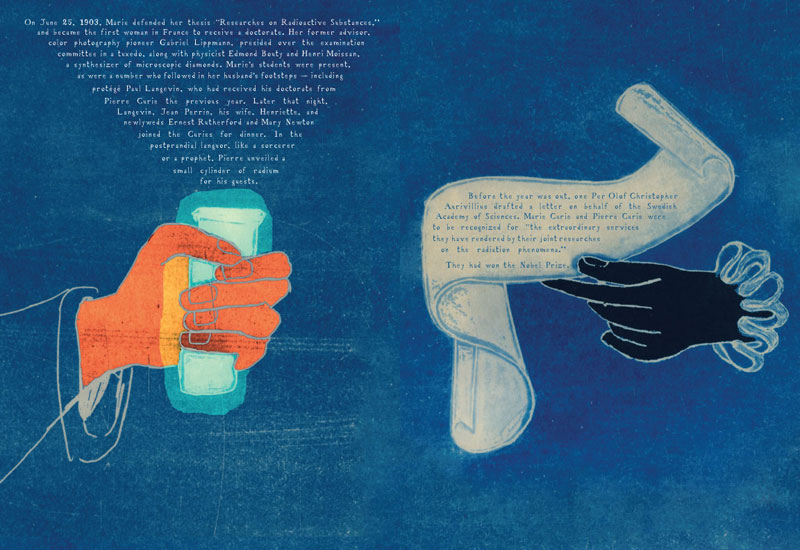
Pages often employ a full-bleed (colour to the edge of the page) that reinforces a slightly ethereal, otherworldly quality. The absence of the authorial frame supports the otherworldly dimension of radioactive materials that were the working tools of Marie Curie’s life. The extent to which she and husband Pierre exposed themselves to these deadly substances soon becomes plain and provokes an immediate anxiety in the heart of the reader. We know this won’t end well. Still, one reads the book with a sense of excitement too. Marie Curie was not a woman to sit aloof from life in her laboratory: she also loved, suffered and survived scandal. Interleaved with the Curie’s life and their discovery of radioactivity, are stories of the implications of their research. Here Redniss uses, for example, eyewitness accounts of Three Mile Island, Hiroshima, and points the way to which nuclear power might fuel space travel. So science is not kept in a museum, put on a pedestal and admired. Author/artist Lauren Redniss shows us some of the consequences of the use of uranium and raises questions that remain urgent.

The pages are beautiful, some Rothko-like in their floating planes of colour. Others exploit reworked photographs, playing with the idea of a scrapbook, an album of memories. This is a book that throws off any shackles of the worthy aspects of non-fiction. I think in the end, Redniss and the reader are suspended between two points. On the one hand we marvel at what Marie Curie achieved, the sacrifices she made - and what science has unlocked. Radioactive is science with a human heart and wonderful, memorable and moving book. Try and catch it.
For a taste of Radioactive, visit the New York Public Library, where Lauren Redniss researched the book.
For a taste of Radioactive, visit the New York Public Library, where Lauren Redniss researched the book.
Lastly, both of these books are published by smaller imprints of major publishers. Let’s hear it for the promotion of experimentation and risk in an age of caution and anxiety.
Libraryland
Libraryland is the result of Oslo Davis's creative fellowship at the State Library of Victoria in 2010.
The subscription model - patrons underwriting a book's production - is just about as old as publishing itself. But, thanks to wonders of social media, pre-pub support has become a whole easier.
Oslo's comics in the Age always bring a chuckle or three around the kitchen table. More about Oslo here.
And more about State Library of Victoria creative fellowships here.
The subscription model - patrons underwriting a book's production - is just about as old as publishing itself. But, thanks to wonders of social media, pre-pub support has become a whole easier.
Oslo's comics in the Age always bring a chuckle or three around the kitchen table. More about Oslo here.
And more about State Library of Victoria creative fellowships here.
Monday, August 15, 2011
Dream of the thylacine
Two years ago I took a plane to Hobart and then a drive down to Huonville, there to meet Ron Brooks, one of Australia's finest book illustrators. I travelled with Sarah Brenan, Ron's editor. At the time Ron was finishing his memoir Drawn From the Heart, which covers his life in books. I wrote about that visit here.

Throughout this year I have been contributing book reviews to Viewpoint, a quarterly magazine on young adult literature. The current issue includes this review of The Dream of the Thylacine, the latest collaboration between author Margaret Wild and illustrator Ron Brooks.


Throughout this year I have been contributing book reviews to Viewpoint, a quarterly magazine on young adult literature. The current issue includes this review of The Dream of the Thylacine, the latest collaboration between author Margaret Wild and illustrator Ron Brooks.

In recent times it almost seems Ron Brooks’s picture books have been offered as rations, the patient readership grateful that there one more book is added to the canon. There is the generous, revealing and invaluable memoir Drawn From the Heart. And if it has been a while between picture books, still have the inexhaustible legacy of those books that made Brooks’s name and reputation as Australia’s finest picture book maker. The Bunyip of Berkeley Creek prepares to celebrate 40 weird and wonderful years, while John Brown, Rose and Midnight Cat (both texts by Jenny Wagner) remains as mysterious and affecting after 35 years. Children may grow up quickly, but great children’s picture books endure.
For Fox (Allen & Unwin, 2000) Brooks created a set of searing images to depict Margaret Wild’s story of trust, betrayal and hope. Likewise, Old Pig, again the text by Margaret Wild, speaks not only of the vulnerable child, but to the knowing adult and to all readers that have lost a parent, a grandparent.
“Who in the world am I?” wonders Alice as she navigates life down the rabbit hole. The bunyip echoes with a question of his own: “What am I?”
What kind of creature was the thylacine? The unfortunate animal is no longer here for us to ask any such probing, so such questions will remain forever moot.
Dream of the Thylacine sits somewhere between the lyricism of Old Pig and the raw power of Fox. Indeed the book swings between two worlds: the Edenic landscapes of Tasmania where the thylacine made its natural home, and the stark, punishing world the zoo, where the last known thylacine died in captivity. Either way, score one more masterpiece into a catalogue crowded with them.
The thylacine is the most lamented, ironically the most celebrated, of Australia’s extinct fauna. We have a right to feel angry about this slaughter, not just misty-eyed. It’s pleasing the Brooks’s treatment of the story invites the reader to feel raw emotions, not merely the approved emotions. But what animals will pass from sight in our lifetime?
Trapped am I,
in a cage of twisty wire, cold concrete.
PROWL
RAGE
HOWL
Brooks has not only created vivid, bristling landscapes. He has also set the text, re-built the simple words so that they grab the reader as pulsing Beat poetry. I like the way the text has been condensed, thickened up, made strong, in this design. It would have be too obvious and too easy to parcel those couplets evenly across the book. This way, the poetry comes roaring to life, the white text is embedded onto stark, monochromatic backgrounds. What might have been a lament becomes a howling rage against the dying light. The image of the thylacine on thext pages is the familiar one: the trapped, dying animal, viewed through wire. The image is degraded, like a fourth-hand photocopy, breaking down like memory. The background on which the bold typeface is impressed, offers another layer of meaning: the weathered timber of farm sheds inverts the pioneer myth. Here the buildings are not signs of progress and expansion but repression and ultimately destruction.
This text never appears on the colour pages, but remains segregated, trapped, as it were, in this world. There is no comfortable fantasy of the animal at one with nature. The landscape is already empty: the last known thylacine recalls the landscape from the cage in which it will die. And this also closes off the clichéd possible that somewhere out there...
The text is also an invitation for Ron Brooks to paint the landscapes of Tasmania that he knows so well. This stark, desperate introduction does give way to the thylacine moving across its native space. The thylacine’s body is sleek and stylised; you just want to stroke its stripy back.
See me swagger across the wild lands...see me glory at the edge of cliff
But this swagger is halted. Everywhere there are limits.
There is an essential drama in the book, that as the trapped thylacine becomes more abject the landscapes, the places of which it dreams and remembers and longs to escape into, become more seductive, more dreamlike, more enchanting.
The poet Auden wrote that "There are good books which are only for adults. There are no good books which are only for children." The Dream of the Thylacine is a book for readers of every age. Teenagers might well respond to its Romanticism. One of the pages in the final is of a bleak mountainside; a scene split by a rainbow, which softens the experience but can’t entirely efface the existential mood. Because I think this is a book about loss and enchantment. It is about finding consolation in place, in the physical world, the same physical world from which the thylacine has been taken.
Tuesday, June 21, 2011
Carrying on
One of the many wonderful things that has come out of my visit to the Angouleme has been the opportunity to work with Bernard Caleo. Mild-mannered museum program officer by day; by nights and weekends Bernard is a comic creator, teacher, publisher and raconteur.
Bernard is currently running What It Is, a monthly program at Readings bookshop in Carlton, exploring the nature and diversity of comics today. Last month I climbed aboard the What It Is express, to revisit Angouleme. This was no ordinary presentation, certainly not your standard powerpoint click and chat, or two fine gentlemen stroking their chins for an audience of bored academics.
What It Is combines storytelling, conversation, performance and humour. Readings bookshop hosts the event - it's free to attend - and makes everyone welcome with a glass or wine or two. This one also included comic writer/illustrator Brenton McKenna, whose first book Ubby's Underdogs was recently published.
Events like What It Is bring people together. Despite appearances I am not really a comic geek. I got into this area out of frustration that there is too little local production of comic book publishing for young people. (Hence the need to go to france, obviously.) I am really pleased to have been able to share my little experience with Melbourne's comics community. Details of the next What It Is can be found here.
Bernard's blog has more photos, including his kamishibai on Jean-Paul Sartre and Simone de Beauvoir. Check it out!
Bernard is currently running What It Is, a monthly program at Readings bookshop in Carlton, exploring the nature and diversity of comics today. Last month I climbed aboard the What It Is express, to revisit Angouleme. This was no ordinary presentation, certainly not your standard powerpoint click and chat, or two fine gentlemen stroking their chins for an audience of bored academics.
What It Is combines storytelling, conversation, performance and humour. Readings bookshop hosts the event - it's free to attend - and makes everyone welcome with a glass or wine or two. This one also included comic writer/illustrator Brenton McKenna, whose first book Ubby's Underdogs was recently published.
Events like What It Is bring people together. Despite appearances I am not really a comic geek. I got into this area out of frustration that there is too little local production of comic book publishing for young people. (Hence the need to go to france, obviously.) I am really pleased to have been able to share my little experience with Melbourne's comics community. Details of the next What It Is can be found here.
Bernard's blog has more photos, including his kamishibai on Jean-Paul Sartre and Simone de Beauvoir. Check it out!
Sunday, May 22, 2011
Autumn music
It has been said that greatest hits albums are like political careers, since both tend to end in failure. Stephen Duffy turns this truism on its head.
Launching himself on the charts as Stephen 'Tin Tin' Duffy, in 1985, Kiss Me was a top five hit in the UK and top 20 in Australia. I remember rolling my eyes that someone would be so desperate to call himself Tin Tin, as if he had any call on this name. I carried on listening to The Smiths/Go-Betweens/Triffids/Chills/REM/etc.
In 1989 I left for a little trip overseas and my friend Jim Payne, late of Dada Records and always of impeccable taste, made a me a C90 with all sorts of things on: Julie Cruise, Devine and Stratton, Kitchens of Distinction...and this one.
Which I had pretty much forgotten about until I received Stephen Duffy's career sampler Memory & Desire: 30 Years in the Wilderness. I have been playing the two-CD set constantly, breakfast, lunch and tea, for the past couple of months.

Hearing 'Lost Girl' after 22 years instantly set my feet tapping, taking imaginary walks around autumnal Hyde Park, Streatham High Street at Christmas, through spring to Kew Gardens and Southbank. It's a song I had forgotten, buried under the leaves, I suppose.
I came back to Stephen Duffy and the Lilac Time by a curious route. In France in early 2008 I read review of the Lilac Time's Runout Groove album. Intrigued, I poked around a few record shops there and in London hoping to find it. No luck. So I forgot them, more or less, but something about that review stuck in my mind. So before we returned to France this year, I went in search of Runout Groove at iTunes. And there it was, $16.99, and no need to leave my study. While I was in France earlier this year, I listened to Runout Groove all the time. It was almost as though the intervening years hadn't happened.
Alexis Petridis at the Guardian reviewed the album here in 2007. In 2009 Caitlan Moran interviewed Duffy for The Times.
Runout Groove is apparently the band's lowest selling record in a three-decade career where under-performing sales became the Lilac Time calling card. The album is loaded with poignant, personal and exquisitely crafted songs. Influences of Nick Drake, Incredible String Band and the Beatles linger but have been turned into something new and lasting. In the 1980s the Lilac Time were darlings of the indie scene, but that doesn't shift units. Not like the 2005 eight million-plus sales of Robbie Williams' Intensive Care, for which Duffy wrote or co-wrote most of the songs. Is that not one of the strangest musical alliances ever? The money he made working for Robbie Williams paid for Runout Groove.
Strange is the word that best describes Duffy's career. He left formed Duran Duran in 1978 and left just as they were getting their flounce on. Showed up briefly in the electro-pop period with a song leaning heavily on the Song of Solomon. Became a Peel favourite, swapping record companies like football cards, formed a band with violinist Nigel Kennedy, moved to Alaska, crashed, returned to England, wrote and toured the world with Robbie Williams, all the time piling up songs and albums that the world largely ignored. He even has an album titled Keep Going (1993). And many of the best songs are gathered up on Memory and Desire.
Duffy reflects in the film Memory and Desire. "What would you call him? A maverick? An outsider? A cult? Or just a failure?"
All of these travails are documented in a film about Stephen Duffy titled Memory & Desire. At least I think so. The film has had limited festival screenings in the UK in 2009 and 2010 and is not currently available on DVD, so I haven't seen it in full. So keen am I that earlier this year I alerted the Melbourne International Film Festival, suggesting they might like to include Memory and Desire in the program, which always runs a section on music documentaries.
I figure that if a low-fi, country-influenced, semi-successful indie band of impeccable taste can't find a home in the hearts of Melbourne inner-city music fans, well, I have cabbages for ears.
I really am a bit obsessed with the Lilac Time. My wife remains politely neutral, and like most, finds them pleasant but not exceptional. But there is something, the sound of a man wrestling with success, with failure, his own worth and place in the world, that has its hooks into me. The songs are seductive, the landscapes timeless, the emotions sharply felt and described in images that linger. As a writer Duffy's songs become more detailed and more direct over time, and shake off the vagueness of early work.
Stephen Duffy turns 51 next week. Happy birthday Stephen Duffy, and may we share Lilac Time for many years to come. This career isn't done yet.
For more Duffy/Lilac goodness, don't miss the Duffypedia, an awesome labour of fan-love.
Launching himself on the charts as Stephen 'Tin Tin' Duffy, in 1985, Kiss Me was a top five hit in the UK and top 20 in Australia. I remember rolling my eyes that someone would be so desperate to call himself Tin Tin, as if he had any call on this name. I carried on listening to The Smiths/Go-Betweens/Triffids/Chills/REM/etc.
In 1989 I left for a little trip overseas and my friend Jim Payne, late of Dada Records and always of impeccable taste, made a me a C90 with all sorts of things on: Julie Cruise, Devine and Stratton, Kitchens of Distinction...and this one.
Which I had pretty much forgotten about until I received Stephen Duffy's career sampler Memory & Desire: 30 Years in the Wilderness. I have been playing the two-CD set constantly, breakfast, lunch and tea, for the past couple of months.
Hearing 'Lost Girl' after 22 years instantly set my feet tapping, taking imaginary walks around autumnal Hyde Park, Streatham High Street at Christmas, through spring to Kew Gardens and Southbank. It's a song I had forgotten, buried under the leaves, I suppose.
I came back to Stephen Duffy and the Lilac Time by a curious route. In France in early 2008 I read review of the Lilac Time's Runout Groove album. Intrigued, I poked around a few record shops there and in London hoping to find it. No luck. So I forgot them, more or less, but something about that review stuck in my mind. So before we returned to France this year, I went in search of Runout Groove at iTunes. And there it was, $16.99, and no need to leave my study. While I was in France earlier this year, I listened to Runout Groove all the time. It was almost as though the intervening years hadn't happened.
Alexis Petridis at the Guardian reviewed the album here in 2007. In 2009 Caitlan Moran interviewed Duffy for The Times.
Runout Groove is apparently the band's lowest selling record in a three-decade career where under-performing sales became the Lilac Time calling card. The album is loaded with poignant, personal and exquisitely crafted songs. Influences of Nick Drake, Incredible String Band and the Beatles linger but have been turned into something new and lasting. In the 1980s the Lilac Time were darlings of the indie scene, but that doesn't shift units. Not like the 2005 eight million-plus sales of Robbie Williams' Intensive Care, for which Duffy wrote or co-wrote most of the songs. Is that not one of the strangest musical alliances ever? The money he made working for Robbie Williams paid for Runout Groove.
Strange is the word that best describes Duffy's career. He left formed Duran Duran in 1978 and left just as they were getting their flounce on. Showed up briefly in the electro-pop period with a song leaning heavily on the Song of Solomon. Became a Peel favourite, swapping record companies like football cards, formed a band with violinist Nigel Kennedy, moved to Alaska, crashed, returned to England, wrote and toured the world with Robbie Williams, all the time piling up songs and albums that the world largely ignored. He even has an album titled Keep Going (1993). And many of the best songs are gathered up on Memory and Desire.
Duffy reflects in the film Memory and Desire. "What would you call him? A maverick? An outsider? A cult? Or just a failure?"
All of these travails are documented in a film about Stephen Duffy titled Memory & Desire. At least I think so. The film has had limited festival screenings in the UK in 2009 and 2010 and is not currently available on DVD, so I haven't seen it in full. So keen am I that earlier this year I alerted the Melbourne International Film Festival, suggesting they might like to include Memory and Desire in the program, which always runs a section on music documentaries.
I figure that if a low-fi, country-influenced, semi-successful indie band of impeccable taste can't find a home in the hearts of Melbourne inner-city music fans, well, I have cabbages for ears.
I really am a bit obsessed with the Lilac Time. My wife remains politely neutral, and like most, finds them pleasant but not exceptional. But there is something, the sound of a man wrestling with success, with failure, his own worth and place in the world, that has its hooks into me. The songs are seductive, the landscapes timeless, the emotions sharply felt and described in images that linger. As a writer Duffy's songs become more detailed and more direct over time, and shake off the vagueness of early work.
Stephen Duffy turns 51 next week. Happy birthday Stephen Duffy, and may we share Lilac Time for many years to come. This career isn't done yet.
For more Duffy/Lilac goodness, don't miss the Duffypedia, an awesome labour of fan-love.
Wednesday, April 20, 2011
Three little gigs
Gig one:
On Wednesday 4 May, I will be speaking with Meg Rosoff at the Wheeler Centre. It's a free event but bookings are preferred. More information here.
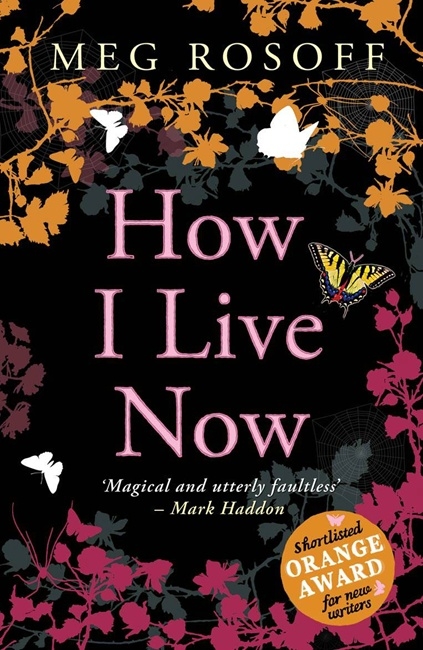
I am a bit of a fan of Meg Rosoff. Her first novel how i live now is a landmark book and a stunning debut. Rosoff worked on and off in advertising for about two decades before changing track with this extraordinary book. Her latest novel, The Bride's Farewell, keeps the standards high. It's a taut, gritty historical novel about a girl who flees from an arranged marriage and survives, somehow, in the fields and farms in C19th England.
UPDATE: The Wheeler Centre posted the video of our conversation here.
Gig two:
On Saturday 14 May, I am giving the final curator's floor talk for Look! The art of Australian picture books today.

Gig three:
Then at the end of the May, Monday 30th to be exact, I am talking at Readings with Bernard Caleo as part of What It Is. This monthly comics event is a kind of an ideas laboratory for all things to do with comics, graphic novels, or in my case, bande dessinee. So I will be talking about Angouleme and what I know about French comics. Shouldn't take long.

On Wednesday 4 May, I will be speaking with Meg Rosoff at the Wheeler Centre. It's a free event but bookings are preferred. More information here.
I am a bit of a fan of Meg Rosoff. Her first novel how i live now is a landmark book and a stunning debut. Rosoff worked on and off in advertising for about two decades before changing track with this extraordinary book. Her latest novel, The Bride's Farewell, keeps the standards high. It's a taut, gritty historical novel about a girl who flees from an arranged marriage and survives, somehow, in the fields and farms in C19th England.
UPDATE: The Wheeler Centre posted the video of our conversation here.
Gig two:
On Saturday 14 May, I am giving the final curator's floor talk for Look! The art of Australian picture books today.
Detail of illustration by Leigh Hobbs from Old Tom’s holiday,
Little Hare Books, 2002, ink, pencil and watercolour on paper,
State Library of Victoria
Gig three:
Then at the end of the May, Monday 30th to be exact, I am talking at Readings with Bernard Caleo as part of What It Is. This monthly comics event is a kind of an ideas laboratory for all things to do with comics, graphic novels, or in my case, bande dessinee. So I will be talking about Angouleme and what I know about French comics. Shouldn't take long.
Bernard Caleo is the publisher of Tango, a comics anthology. He is brilliant at making comics, talking about comics, and performing comics, so I am looking forward to that. It's sure to be a unique experience. Also speaking on the night is Brenton McKenna, Broome-based comic writer and illustrator, whose book, Ubby's Underdogs comes out very soon. I met Brenton last year when he still working on this book so I am dying to see the final results. As my conversation with Bernard is around creating Australian comics Brenton's experience should be fascinating.
Subscribe to:
Posts (Atom)