This time last year I translated a summary of annual bande dessinée sales activity in France. Lo and behold, the good people of toutenbd.com have posted the 2012 report by the Association of Bande Dessinee Journalists and Critics (l'ACBD).
It would appear that despite the stalling economy of France, and of Europe more generally, activity in graphic novel publishing, buying and reading remains reasonably healthy, though the stagnant economy is not without implications for the industry.
In the interests of spreading the word about bande dessinée to English language readers, here's my translation of the toutenbd summary. If you would prefer the original text, you can read it here in French.
Bande dessinnee 2012: proliferation and polarisation
The annual meeting of the Association of Critics and Journalists of Bande Dessinée has again noted the increased number of books published but also that four publishers largely dominate the sector.
The traditional annual report from the general secretary of the Association of Critics and Journalists of Bande Dessinée (ACBD) Gilles Ratier, has been handed down for 2012. For the seventeenth consecutive year the number of books (albums) published has increased: 4.28% growth from 2011, to 5,565 books published in 2012, of which 4,109 were new titles.
The growth of new titles is in four distinct areas: Franco-Belgian bande dessinée; manga; American comics (genre comics); graphic novels and experimental books, creating a more complicated arrangement of titles and presentation of albums in bookshops, Gilles Ratier reported.
Eighty-nine series or complete works of authors succeeded in selling more than 50,000 copies (ten less than for 2011) and providing the industry's core sales. The five highest sales are: one million copies of volume 13 of Titeuf by Zep (published by Glénat); 450,000 sales for the fifth Lucky Luke by Daniel Pennac, Tonino Benacquista and Achdé (Lucky Comics); 440,000 copies of Largo Winch, volume 18, by Jean van Hamme et Philippe Francq (Dupuis); 440,000 copies of Blake and Mortimer, volume 21, by Yves Sente and André Juillard; and 350,000 sales for XIII, volume 21, by Yves Sente and Iouri Jigounov (Dagard Benelux). In regard to manga, it's no surprise that Naruto, with three new titles each selling 225,000 (Kana); One Piece with five books between 135,000 and 165,000 (Glénat) and Fairy Tale's six titles each selling 85,000 (Pika).
As in previous years, the report notes a strong segmentation within the market: four groups - Delcourt (Akata, Tonkam, Soleil Manga and Quadrants), Media-Participations (Dargaud, Kana, Le Lombard, Dupuis, Graton, Blake and Mortimer, Lucky Comics, Fleurus/Edifa/Mame, Mediatoon Publishing, Huginn & Muninn, Urban Comics), Glénat (Comics, Disney, Mangas, Treize étrange et Vents d'Ouest) and Gallimard (Casterman, KSTR, AUDIE/Fluide glacial, Jungle, Denoel Graphic and Futuroplis) - dominating the production and activity in the sector with 44.87% of production, and that 326 publishers and/or imprints published bande dessinee in 2012 (against 316 in 2011).
Once again, development around digital publishing of bande dessinee is very cautious, so that those concerned with digital publishing more concerned with creating digital imprints (Iznéo, digiBiDi, etc) than the creation of purely digital content (Plumzi, for example).
The legal access progressed less quickly than the pirate copies (10,000 titles are easily accessible according to the l'Observatoire du livre et de l'ecrit en Ile-de-France) with hardly 6,000 available. On the other hand, crowd-sourcing is established with Sandawe (28 projects drawing together half-a-million euros), My Major Company (17 projects, 172,000 euros) and Ulule (14 projects, 26,000 euros) who come together and are launching print publications.
Buzzcomics draws on the l'ACBD report to show the extent of events for Franco-Belgian comics, including festivals, fairs, markets. They note that in francophone Europe in 2012, there were 489 festivals, fairs, markets and industry gattherings - and that the extent of this activity is continuing to expand, particularly in France.
Showing posts with label bande dessinee. Show all posts
Showing posts with label bande dessinee. Show all posts
Tuesday, January 1, 2013

Saturday, January 14, 2012
Bande dessinée by numbers
The excellent ToutenBD.com, the French website dedicated to all things French graphic novels, recently posted the annual health check of the industry. Despite the economic straits France finds itself in, the comics industry continues to grow. While the overall picture seems quite healthy, a closer look reveals a more interesting picture. And students of the Australian publishing sector will certainly draw some parallels with our colleagues francaise.
Being on holiday and at something of a loose end, I have written a translation of the article, and added links. ToutenBD.com were contacted for permission but have not yet replied. You can read the original version at the website.
In the meantime, allons-y!
Bande dessinee is 2011: the boom of the sure thing
The annual meeting of the Bande Dessinée Critics Association (Association de critiques et tournalistes de bande dessinée) noted again this year the growth of the production of albums (books) -- but with the caution that publishers are supporting the safe bets.
The traditional annual report from Gilles Ratier, the general secretary of the Bande Dessinée Critics Association (ACBD) has been delivered for 2011.
For the sixteenth consecutive year, the production of albums has increased: 3.04% against 2010; an increase of 162 titles, for a total of 5,327 albums. However the report noted "the economic conditions are hardly favourable for industry, which for three years has lacked a strong engine. Hence, we have a general climate of watchfulness, highlighting safety first and anxiety!"
Watchfulness in effect because of the 5,327 albums only 3,841 are strictly new (of which only 1,577 originated in francophone Europe). The traditional publishing sector (le secteur patrimonial) is fully expanded, with 1058 new releases, compilations or bind-ups (980 in 2010), 224 woks dating from more than 20 years published finally in album and 31 francophone series reprised or continued by new creators.
Watchfulness also because in 2011 on 99 "sure things" (valuers sûres), had sales of more than 50, 000 copies and bestowing the bulk of sales on this sector. At the head of these 'locomotives' are: XIII (500,000 copies); Kid Paddle (360, 000) and Boule et Bille (253,000). Counting manga, ten series (from five publishing houses) provided 50% of sales, Naruto at the head (250,000 copies of each of three titles in the series).
Looking at publishing houses, 310 publishers produced bande dessinée in 2011. And yet the trend towards concentration is again confirmed: four groups accounted for 43.6% of production. With the acquisition of the majority share of the publisher Soleil by Guy Delcourt, Delcourt became by far the biggest producer of albums with 840 titles, being 15.77% of production.
On the economic graph, the prize nevertheless gos to Médias-Participations group (Dargaud, Le Lombard, Dupuis, etc).
The report noted the strong success of the bande dessinée blogs, which have become a "fishtank" (un vivier) for the print publications. On the other hand few were seduced by the e-book. And bande dessinée is always well exposed in the news stands, with 76 specialist journals.
FIN
So, thanks again to ACBD and ToutenBD. And apologies for all infelicities in 'la traduction'.
Being on holiday and at something of a loose end, I have written a translation of the article, and added links. ToutenBD.com were contacted for permission but have not yet replied. You can read the original version at the website.
In the meantime, allons-y!
Bande dessinee is 2011: the boom of the sure thing
The annual meeting of the Bande Dessinée Critics Association (Association de critiques et tournalistes de bande dessinée) noted again this year the growth of the production of albums (books) -- but with the caution that publishers are supporting the safe bets.
The traditional annual report from Gilles Ratier, the general secretary of the Bande Dessinée Critics Association (ACBD) has been delivered for 2011.
For the sixteenth consecutive year, the production of albums has increased: 3.04% against 2010; an increase of 162 titles, for a total of 5,327 albums. However the report noted "the economic conditions are hardly favourable for industry, which for three years has lacked a strong engine. Hence, we have a general climate of watchfulness, highlighting safety first and anxiety!"
Watchfulness in effect because of the 5,327 albums only 3,841 are strictly new (of which only 1,577 originated in francophone Europe). The traditional publishing sector (le secteur patrimonial) is fully expanded, with 1058 new releases, compilations or bind-ups (980 in 2010), 224 woks dating from more than 20 years published finally in album and 31 francophone series reprised or continued by new creators.
Watchfulness also because in 2011 on 99 "sure things" (valuers sûres), had sales of more than 50, 000 copies and bestowing the bulk of sales on this sector. At the head of these 'locomotives' are: XIII (500,000 copies); Kid Paddle (360, 000) and Boule et Bille (253,000). Counting manga, ten series (from five publishing houses) provided 50% of sales, Naruto at the head (250,000 copies of each of three titles in the series).
Looking at publishing houses, 310 publishers produced bande dessinée in 2011. And yet the trend towards concentration is again confirmed: four groups accounted for 43.6% of production. With the acquisition of the majority share of the publisher Soleil by Guy Delcourt, Delcourt became by far the biggest producer of albums with 840 titles, being 15.77% of production.
On the economic graph, the prize nevertheless gos to Médias-Participations group (Dargaud, Le Lombard, Dupuis, etc).
The report noted the strong success of the bande dessinée blogs, which have become a "fishtank" (un vivier) for the print publications. On the other hand few were seduced by the e-book. And bande dessinée is always well exposed in the news stands, with 76 specialist journals.
FIN
So, thanks again to ACBD and ToutenBD. And apologies for all infelicities in 'la traduction'.
Tuesday, November 1, 2011
Viewpoint again
The latest issue of Viewpoint: on books for young adults, includes my review of two recent graphic novels. Neither book fits easily into the received notion of 'graphic novel', which is probably why I like them so much. Thanks to Pam Macintyre and the team for publishing the reviews.
A Taste of Chlorine
Bastien Vivès (Jonathan Cape, hbk)
and
Radioactive: Marie & Pierre Curie A tale of love and fallout
Lauren Redniss (It Books/HarperCollins) hbk


A Taste of Chlorine (Goute de Chlore) by Bastien Vivès, the young Parisian writer/illustrator won the Revelation Award for best first book at Angouleme in 2009, Europe’s biggest comics festival. Simply put, A Taste of Chlorine is the story of a teenage boy ordered by his doctor to swim regularly to repair a damaged spine. At the pool, he comes into contact with a young woman who offers him advice on swimming technique and companionship. As their tentative relationship develops, companionship leans towards attraction.
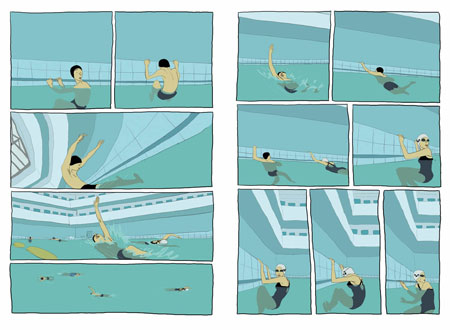
Most of the action takes place at the pool and in the water. Bastien Vives delights in depicting the body’s curves and lines in all its various positions, shapes and poses. What, after all, is swimming, if not contorting the body into striking shapes? All those aquatic blues and greens lend the book a certain cool mood, punctuated by the black ribbon of the lap lanes. The minimalism of the colour and location allows the viewer to attend more closely to the emotional exchanges, since below the surface however and emotional drama of subtly and force plays out. In this regard A Taste of Chlorine is a remarkable debut, a book where the artist shows us what he can do within the tight confines of setting. Vives exploits perspective and point of view with some authority. It is also a book that is long on visuals and lighter on text, but that doesn’t mean that viewers will simply skim the book (The act of swimming is not a language-based activity, so why not remove all but necessary language from the pages?) The drawing sometimes appears simple, even at times rudimentary, but this is somehow in keeping with the story’s unaffected emotional tone.

One reads this book as one watches a film, where the dynamics of space and gesture are all important. Vives also neatly exploits the use of the ‘frame’ or panel as a way of isolating his characters. There are points where the panel behaves like the lanes of a pool, bringing the swimmers closer yet exquisitely resisting the shared moment so desired by the young man. A Taste of Chlorine does not give up its secrets easily. Perhaps it doesn’t need saying that the book will not be to everyone’s favour. But this quiet, deftly told drama challenges some received ideas of the graphic novel. The ending is enigmatic, open, and will have keen viewers returning again and again, to tease out the elusive relationship at the heart of the story. A Taste of Chlorine is also an example of the innovation that the French graphic novel, la bande dessinee, is capable of achieving, as artists and writers explore the creative potential of the form.

Radioactive works differently. It’s a book relatively long on text and strictly speaking, is not really a graphic novel. Well, insofar as it does not use the panel structure to tell its story, and avoids speech balloons. But the life of Marie Curie, the remarkable scientist, is passionately communicated through sophisticated picture-making and bold page design. Again, the drawing style has a slightly ungainly, improvised manner, which is belied by the confident use of colour to shape mood and emotional response in the reader. After all, an account of a scientist whose major work was more a hundred years ago, may not immediately hold great interest for the reader today. That this world is remote gives way at the first glance of the endpapers. (Doubt stops at the border.)
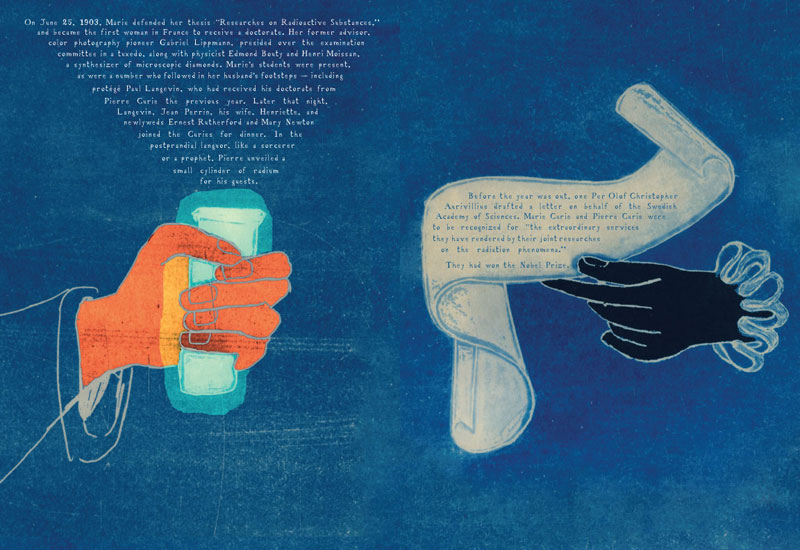
Pages often employ a full-bleed (colour to the edge of the page) that reinforces a slightly ethereal, otherworldly quality. The absence of the authorial frame supports the otherworldly dimension of radioactive materials that were the working tools of Marie Curie’s life. The extent to which she and husband Pierre exposed themselves to these deadly substances soon becomes plain and provokes an immediate anxiety in the heart of the reader. We know this won’t end well. Still, one reads the book with a sense of excitement too. Marie Curie was not a woman to sit aloof from life in her laboratory: she also loved, suffered and survived scandal. Interleaved with the Curie’s life and their discovery of radioactivity, are stories of the implications of their research. Here Redniss uses, for example, eyewitness accounts of Three Mile Island, Hiroshima, and points the way to which nuclear power might fuel space travel. So science is not kept in a museum, put on a pedestal and admired. Author/artist Lauren Redniss shows us some of the consequences of the use of uranium and raises questions that remain urgent.

The pages are beautiful, some Rothko-like in their floating planes of colour. Others exploit reworked photographs, playing with the idea of a scrapbook, an album of memories. This is a book that throws off any shackles of the worthy aspects of non-fiction. I think in the end, Redniss and the reader are suspended between two points. On the one hand we marvel at what Marie Curie achieved, the sacrifices she made - and what science has unlocked. Radioactive is science with a human heart and wonderful, memorable and moving book. Try and catch it.
For a taste of Radioactive, visit the New York Public Library, where Lauren Redniss researched the book.
For a taste of Radioactive, visit the New York Public Library, where Lauren Redniss researched the book.
Lastly, both of these books are published by smaller imprints of major publishers. Let’s hear it for the promotion of experimentation and risk in an age of caution and anxiety.
Thursday, October 29, 2009
Angouleme dreaming
When we went to France last year (like it's something we do often), the idea jumped into my head that I might come back and explore the world of la bande dessinee. Everybody knows the French and Belgians are nuts about graphic novels and everybody knows and has probably read some Tintin and Asterix.


But the whole French graphic novel thing jumped to the front of my mind when, coincidentally, Shaun Tan won the Angouleme International Comics Festival Prize for La Ou Vont Nos Peres. Although we probably know it best as The Arrival. So yay, Shaun.

Today I read the Angouleme Comics Festival is 'the largest and most significant comics festival in the world. (So says Bart Beaty in Unpopular Culture, transforming the European comic book in the 1990s). So you might say that to win such a award is the comic universe equivalent of the Booker Prize. Or Le Tour de France.
Anyway, I got thinking that I might like to go there to find out how the French do things and why it is that la bande dessinee maintains such a broad audience. Why is it that comic books are seemingly not viewed as the preserve of pimple squeezing dweebs, would-be manga cultists or indie hipsters? Hey, maybe the French really do look down the Gallic conk at comic book readers. But what the heck, the industry is large, diverse and ever-changing. Not without its problems I'm sure but big and complex.
At least I hope so. Because this week I learned the good people at the Copyright Agency Limited have provided me with a little money to travel to Angouleme in January 2011 to attend the festival. So yay, CAL. I would love to go this January, but the year's gap gives me time to plan and set up other activities. And save some euros. And keep learning the language.
Subscribe to:
Posts (Atom)